The Mechanics of Mental Paralysis
Most mental suffering does not stem from external events, but from unquestioned interpretations of those events. When a project stalls, the brain asserts: "I have failed, and everyone knows it." When a partner becomes quiet, the thought follows: "They are pulling away."
Because these thoughts trigger an involuntary release of cortisol and adrenaline, the nervous system treats the assumption as a physical emergency. Byron Katie developed a practical self-inquiry process known as "The Work" to interrogate these mental assertions before they become compulsive loops.
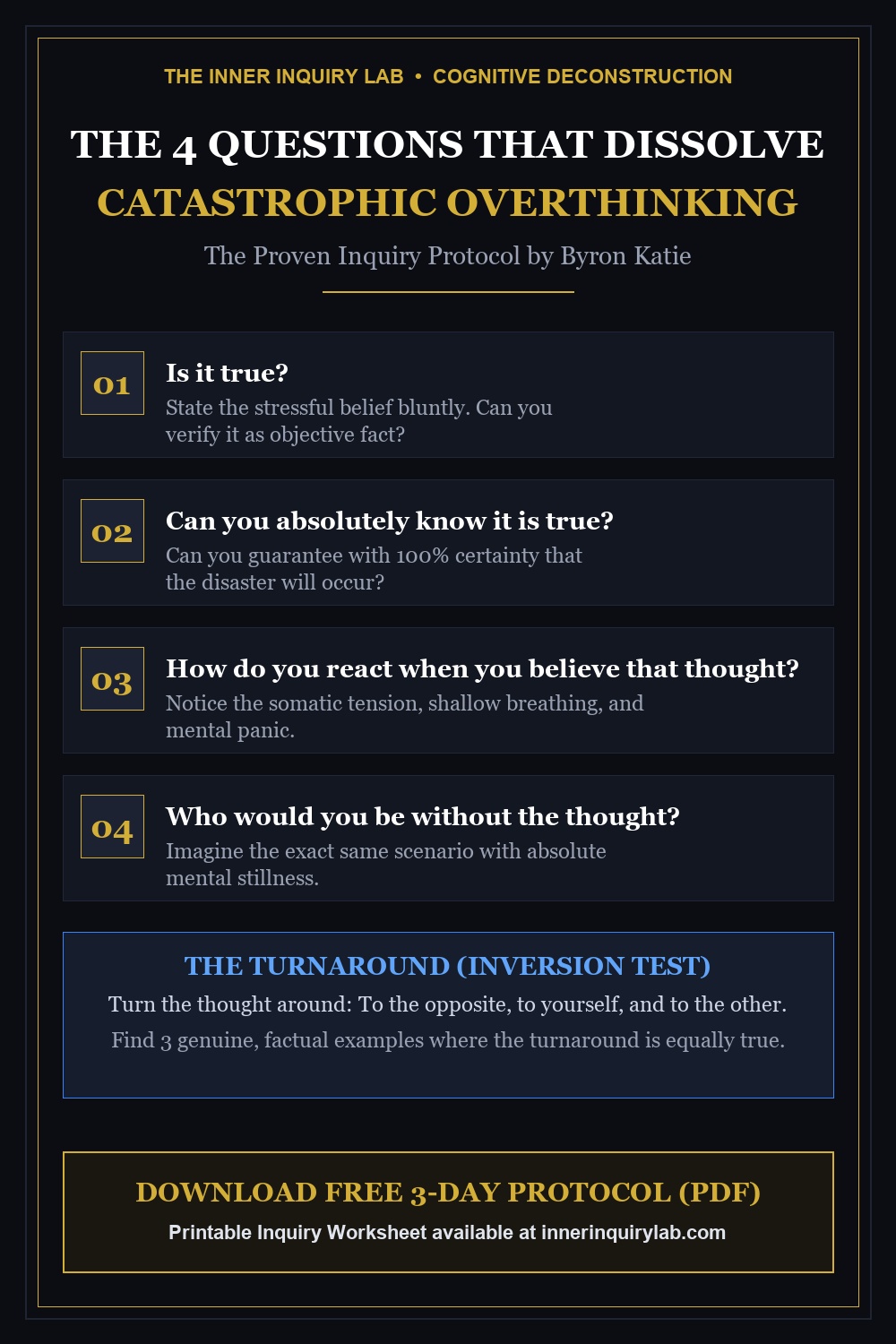
The 4 Core Questions of Inquiry
Question 1: Is it true?
State your painful belief in a single, unvarnished sentence. Examples: "My team does not respect my decisions," or "I am wasting my potential." Look at the situation as an external observer. Can you verify with objective facts that this statement is reality right now? Answer with a simple yes or no.
Question 2: Can you absolutely know that it is true?
Consider whether you can possess complete, omniscience-level proof that your interpretation is an undeniable certainty. Can you know what other people think in their private moments? Can you know that the current delay will result in ruin? In almost every case, the honest answer is no.
Question 3: How do you react when you believe that thought?
Track the physical and behavioral chain reaction. Notice how your breathing alters, where tension tightens in the shoulders or stomach, and what defensive actions you begin taking. Does believing this thought make you defensive, withdrawn, or irritable? Notice the toll the thought takes on your body.
Question 4: Who would you be without the thought?
Close your eyes and picture yourself in the exact same room, facing the exact same challenge, but completely unable to think that specific thought. Notice the relief in the chest and the restoration of clear perception. The situation has not changed; only your attachment to the internal narrative has dropped.
The Turnaround Exercise
After questioning the initial thought, you turn the sentence around in three directions:
- To the opposite: "My team respects my decisions" (or "I am not wasting my potential").
- To the other: "I do not respect my team's decisions."
- To yourself: "I do not respect my own decisions."
For each turnaround, find three concrete, specific examples from your daily life where that version is just as true or truer than the original complaint. This exercise interrupts confirmation bias and trains cognitive flexibility.
Integrate This Practice With Daily Templates
Download our free 3-Day Shadow Work Journal PDF containing structured morning inquiry sheets and cognitive audit templates.
Download Free 3-Day Protocol (PDF)Primary Literature & Citations
- Katie, Byron & Mitchell, Stephen (2002). Loving What Is: Four Questions That Can Change Your Life. Harmony Books.
- Beck, Aaron T. (1979). Cognitive Therapy of Depression. Guilford Press.
- Marcus Aurelius. Meditations, Book IV, Chapter 3: On retreating into one's own mind for tranquility.