The Mechanics of Childhood Conditioning
Every child requires physical safety and emotional belonging to survive. When a caregiver expresses irritation toward loud exuberance, tears, or anger, the developing mind reaches a rapid survival conclusion: *this part of me endangers my security*. To maintain attachment, the child exiles that trait into the shadow.
Decades later, the adult does not experience themselves as having exiled part of their psyche. Instead, they experience chronic exhaustion, hyper-vigilance, an inability to say no, or sudden bouts of inexplicable resentment toward confident people. Healing requires locating the exact conditions under which the contract was signed.
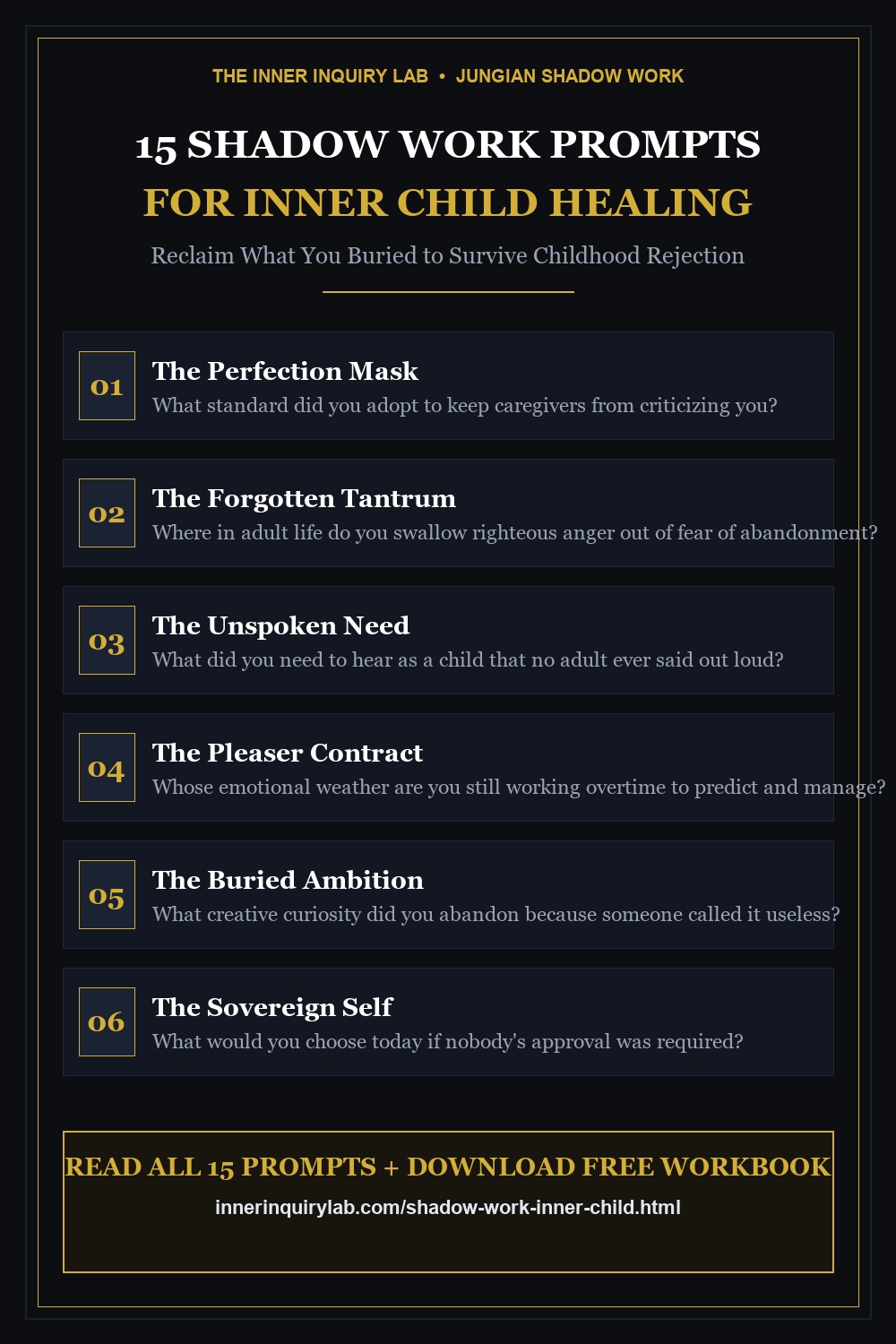
The 15 Diagnostic Prompts
- The Performance Audit: What standard of achievement did you have to maintain so your caregivers wouldn't criticize, ignore, or worry about you?
- The Disowned Tantrum: Where in adult life do you swallow legitimate anger because you were taught that anger makes you unlovable or dangerous?
- The Missing Sentence: What sentence did you desperately need to hear as an eight-year-old child that no authority figure ever offered you?
- The Household Weather: Whose unpredictable mood were you forced to read and navigate like a barometer growing up? Whose anxiety are you still managing today?
- The Abandoned Curiosity: What creative passion, sport, or eccentric hobby did you hide because someone laughed or called it a waste of time?
- The Hyper-Independence Trap: When did you decide that asking for assistance was weakness and that nobody would ever show up to help you?
- The Good Girl/Boy Burden: What dangerous or exhausting obligations do you accept today simply to keep people from thinking you are selfish?
- The Shame Signature: What physiological sensation did you feel when you were scolded—a lump in the throat, burning cheeks, or collapsing chest? Where does that exact feeling reappear in your career?
- The Comparison Trap: Who was held up as the "golden child" in your circle, and what resentment are you still harboring against their memory?
- The Boundary Penalty: What happened the first time you tried saying "no" to a parental figure? Were you met with silent treatment, rage, or guilt trips?
- The Disowned Need: What physical or emotional comfort do you constantly deny yourself today, telling yourself you "haven't earned it yet"?
- The Fear of Being Seen: What do you secretly fear would happen if people discovered you are not as composed, competent, or happy as you present?
- The Money Blueprint: What unspoken money trauma (poverty panic, secret spending, control) did you inherit from your household?
- The Parentification Wound: Did you have to act like the emotional adult for your parents? What part of childhood play did that steal from you?
- The Sovereign Decision: If your childhood caregivers could never witness, judge, or know about your life, what decision would you make tomorrow morning?
Take The Complete 30-Day Guided Journey
Ready to go beyond single questions? The 30-Day Shadow Work Mastery Workbook breaks subconscious loops with printable daily tracking sheets and somatic integration rituals.
Access The 30-Day Workbook ($27) →Foundational Reading
- Jung, Carl G. (1959). Aion: Researches into the Phenomenology of the Self. Bollingen Series XX.
- Miller, Alice (1981). The Drama of the Gifted Child: The Search for the True Self. Basic Books.
- Bradshaw, John (1990). Homecoming: Reclaiming and Championing Your Inner Child. Bantam Books.