Why Others Irritate Us More Than They Should
Every person experiences moments when someone else's behavior produces a disproportionate wave of anger, disgust, or contempt. A colleague speaks loudly in a meeting, and irritation flares within seconds. An acquaintance posts about an accomplishment online, and an immediate cynical thought arises.
In standard cognitive psychology, people explain this by blaming external rudeness. In Carl Jung's model of analytical psychology, however, an exaggerated reaction indicates that an unconscious conflict has been activated. The external person acts as a projection screen for an internal rule you enforce against yourself.
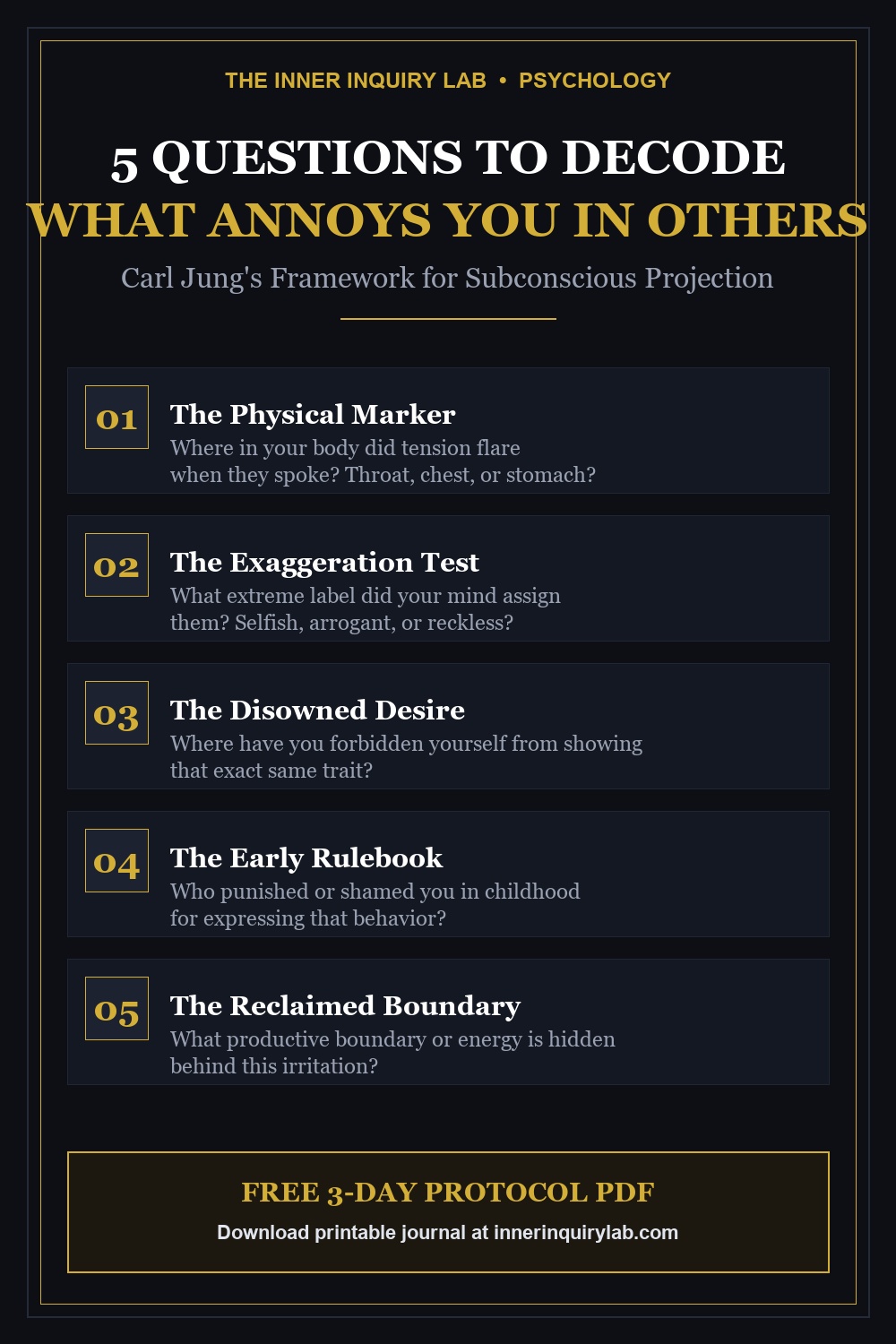
The 5-Step Inquiry Protocol
When you feel an involuntary surge of irritation toward a person or situation, apply this five-stage inquiry rather than reacting outward.
Step 1: Locate the Physical Marker
Emotional projection begins as a bodily contraction before it turns into words. Notice where tension gathers. For most people, it registers in a tightened throat, shallow breathing, or abdominal tightening. Acknowledging the physical sensation prevents automatic verbal retaliation.
Step 2: Run the Exaggeration Test
Examine the label your mind instantly applied to the person. Labels like "arrogant," "lazy," "selfish," or "attention-seeking" are rarely measured assessments. When an adjective carries emotional charge, the mind is defending an internal rule.
Step 3: Identify the Disowned Desire
Ask yourself: where in my life have I strictly forbidden myself from showing this behavior? If someone's assertiveness irritates you as "arrogance," you likely carry a strict childhood rule that staying quiet is necessary for safety or approval.
Step 4: Audit the Early Rulebook
Trace the origin of that rule. Who taught you that expressing needs was selfish? Who punished you for being noisy, emotional, or ambitious? Recognizing that this rule was an adaptation to an earlier environment frees you from having to enforce it today.
Step 5: Reclaim the Functional Boundary
Shadow traits contain useful energy once separated from toxic expression. You do not need to become reckless, but you may need the courage to speak up. The irritation is an indicator pointing directly toward an underdeveloped psychological boundary.
Put This Protocol Into Practice
Download our free, printable 3-Day Shadow Work Journal PDF with guided morning prompts and somatic tracking templates.
Download Free 3-Day Protocol (PDF)Scientific References & Primary Literature
- Jung, C. G. (1959). The Archetypes and the Collective Unconscious, Collected Works Vol. 9, Part 1. Princeton University Press.
- Levine, P. A. (2010). In an Unspoken Voice: How the Body Releases Trauma and Restores Goodness. North Atlantic Books.
- Epictetus. The Discourses, Book I, Chapter 18: On how we ought not to be angry with those who err.