The Illusion of Thinking Your Way Out of Anxiety
When the autonomic nervous system senses unhandled stress, the brain accelerates internal dialogue. You rehearse catastrophic scenarios, re-read emails ten times, and analyze personal relationships obsessively. This hyper-intellectualization is an autonomic coping defense.
The mind believes that if it just thinks harder, it will find certainty. But the rumination is fueled by high vagal inhibition and an elevated resting pulse. You cannot debate an overactive autonomic nervous system into peace. You must speak its physical language.
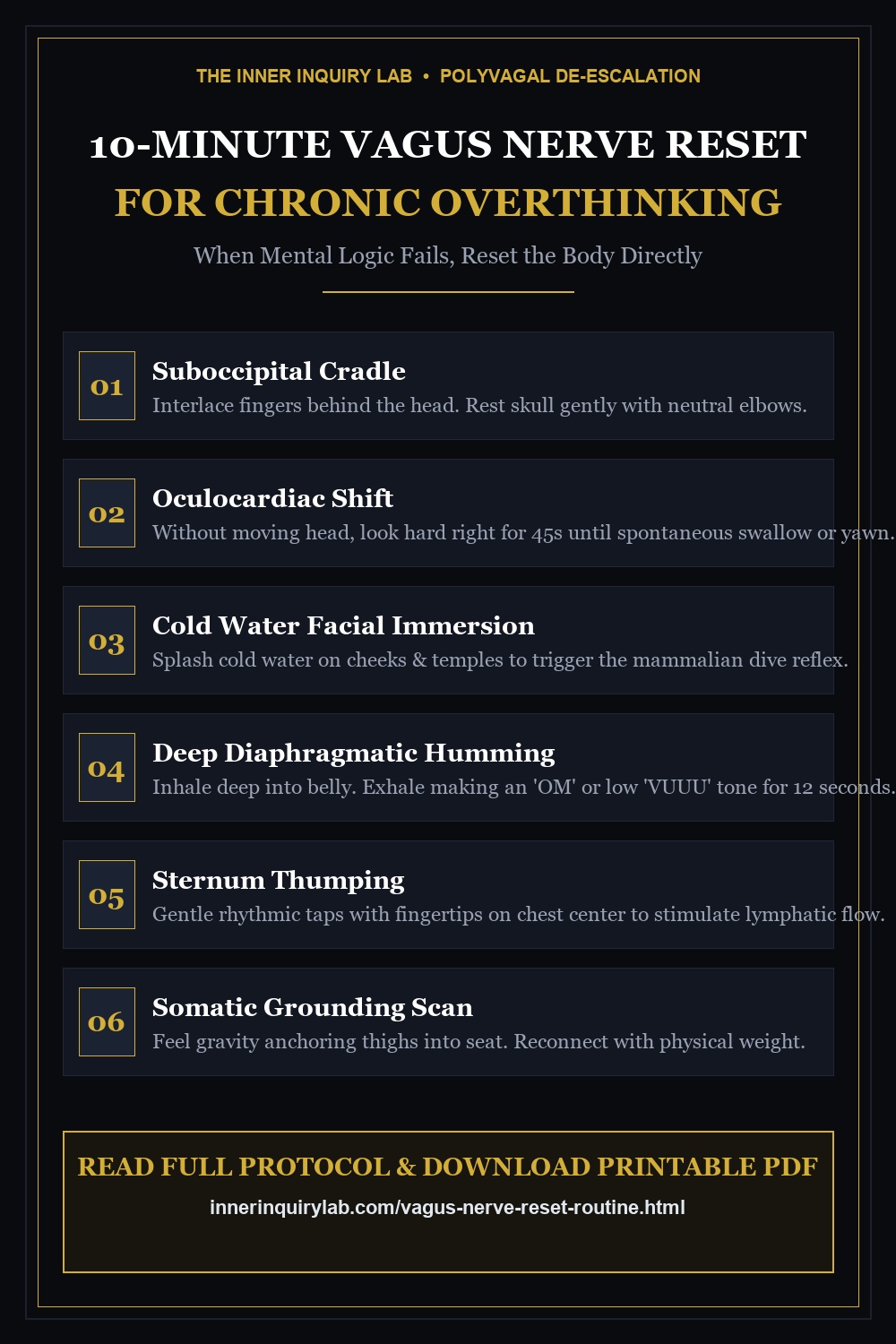
The 6-Step De-escalation Protocol
1. The Suboccipital Cradle (2 Minutes)
Interlace your fingers and place both hands behind your head, supporting the occipital ridge at the base of your skull. Allow the weight of your head to rest gently into your palms without pulling forward. This softens the suboccipital muscles directly adjacent to the jugular foramen where the vagus nerve exits the cranium.
2. The Oculocardiac Shift (60 Seconds)
Keeping your head strictly neutral, shift only your eyes as far to the right as possible. Hold your gaze on a fixed point. Within 30 to 60 seconds, your autonomic system will register safety, signaled by an involuntary swallow, sigh, or deep spontaneous breath. Return eyes to center and repeat on the left.
3. Cold Water Facial Immersion (30 Seconds)
Splash cold water over your eyes, temples, and upper cheeks. The ophthalmic branch of the trigeminal nerve senses cold water and immediately activates the mammalian dive reflex, instructing the heart to slow rhythm and dropping arterial blood pressure.
4. Diaphragmatic Low Humming (2 Minutes)
Inhale deeply through your nose, expanding the 360-degree lower ribcage. On the exhalation, vibrate your vocal cords with a prolonged low-frequency "VUUU" or "MMMM" sound. The vagus nerve branches directly into the larynx and pharynx; mechanical sound vibrations mechanically stimulate its motor fibers.
5. Sternum Tapping (60 Seconds)
Use fingertips or a loose fist to gently tap the center of your chest bone. Breathe slowly. This stimulates the thymus and releases tension in the fascial sheath wrapping the heart and anterior vagal trunk.
6. Somatic Grounding Confirmation (90 Seconds)
Place both feet flat on the floor, remove shoes if possible, and note three concrete physical realities: the density of the chair beneath you, the temperature of air entering your nostrils, and the absence of physical danger in the room right now.
Download The Free Somatic Tracking Journal
Track your nervous system states morning and evening. Download our 3-Day Shadow Work & Nervous System Journal PDF with instant access.
Download Free PDF JournalScientific References
- Dana, Deb (2018). The Polyvagal Theory in Therapy: Engaging the Rhythm of Regulation. W. W. Norton & Company.
- Porges, Stephen W. (2017). The Pocket Guide to the Polyvagal Theory: The Transformative Power of Feeling Safe. W. W. Norton & Company.
- Gerritsen, R. J. S., & Band, G. P. H. (2018). Breath of Life: The Respiratory Vagal Stimulation Model of Contemplative Activity. Frontiers in Human Neuroscience.